Enhanced Macro Simulation based on Karma System, City Stability, Shared Groups and Events (Cities Skylines inspired and optimized)

Feels like a fusion of the Karma System thread and the ideas based on City Stability Control. I really appreciate these fantastic ideas and would love to highlight some of them separately.

:video_game: Why This Matters

The Karma system now tracks over 250 Zois plus 12 residential lots — meaning roughly 250–300 agents in active simulation. The game hands you full responsibility for their Karma and simulates all of them on your CPU, even though many serve no real purpose beyond (distracting) background noise. For many players, the real focus is their own household. And yet, even with this amount of Karma-tracked Zois, the city still doesn’t feel truly alive.

That’s why I suggest putting some of them into agent simulation (incl. offline) — like in Sims 3, some in macro / group simulation, where multiple agents are simulated as part of a shared behavioral system and letting the rest act as crowd filler, driven purely by globally set sliders, etc.

Partial references: Cities: Skylines, Watch Dogs: Legion

:level_slider:City Stability Global Sliders

The global sliders shown in the screenshot need to be made more impactful. For example, if the City Safety is low, the city should feel unsafe: actual crimes and arrests happening around the city. Same with Health Level — outbreaks, ambulances rushing around.
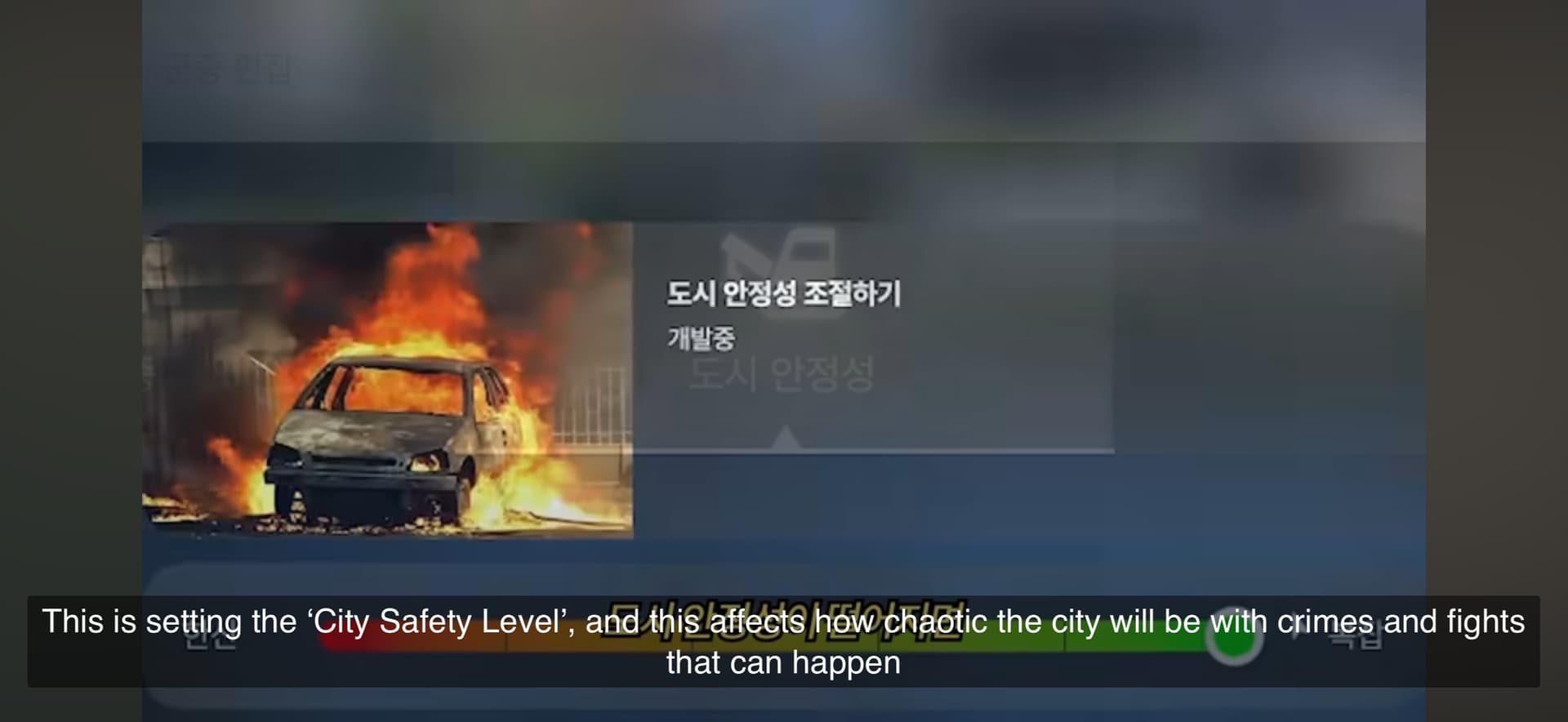

Source: Can ‘InZOI’ Stop the 97.5% Monopoly of The Sims? #inzoi #interview #lifesim

This way, players would simply configure the city to their liking, with a toggle for dynamic City Stability changes — allowing Karma system to modify this parameters or remain static, so that multiple gameplay scenarios can coexist within a single city.

Scarlett: I wish the karma system would show actual consequences, when the karma is very low and a lot of people fall under the bad zoi category, the city should be more prone for crime and stuff.

Dattgal: On a player’s home lot there could be more of a chance that your house can be burgled or vandalized. Having a porch pirate steal your packages or the stuff you ordered arrive damaged can be a result of negative carma. Or even your Zoi is more likely to get scammed online.

SmallArchangel: Karma system also could be connected to the City Appearance, so that the city would become more dirty and run-down as the low-karma citizens take less responsibility (broken windows, evidence of crime and trash everywhere
) Now that would be a real and tangible consequence.

joyfuljj: Instead of being something to force you to play morally good characters, it could simply be more of a basis for what NPC characters do, feel, and experience in their day to day life!

At the same time, allow Karma system tracking only for followed Zois, reflecting how players typically manage households or control broader city behavior (Disabled → Only My Zoi → Only Active Family → Followed Resident Familes (for Family Rotation) → Followed Zois up to 255)

theboynub: It seems to me that it should definitely be like this: a switch and setting up functions.

:bird: Local Twitter (Chirper, Bubbly)

A kind of local Twitter triggered in response to Karma/City Stability states, flooded with complaints or cheers — similar to Chirper from Cities: Skylines. Every actively simulated (followed) Zoi could share posts reflecting their emotions, intentions, and their personal milestones (lifepath by CSII).

joyfuljj: An app like that as like a feed on inZoi to get a glimpse into lives of others, gossip, ups and downs would be cool.


New Bubbly App concept!


:busts_in_silhouette: Macro / Group Simulation

How can this dynamic be implemented, considering that so many players want to see both Zoi group activities and a significant layer of textured events such as crime?

Zois generated by the game and actively simulated (250+ by default) could be grouped into families that the game tracks based on preset scenarios (50, 100, 
). Each family has a plot and a type — single, with partner, children, elderly, 
 — which determines how the game assigns them to social groups and gathers them into family groups.

When it comes to housing for these Zois (officially without a home), I’m reminded of a Discord post suggesting that all Zois in the simulation should be able to rent housing. Just like in other games, it could be a simple rabbit hole — especially since some Zois already leave random homes. Maybe Bliss Bay shouldn’t be downsized after all?

At the start of the cycle, pathfinding and regrouping begin.

Employed Zois go to work (in working groups), children go to school (in school groups). Transport depends on availability: walking, bicycle, public, car; efficiency and tiers influenced by Enneagram+MBTI and Karma.

Free Zois may cluster into social groups and participate in shared activities (Various activity options for Zois are presented here: ( City Activities — Crowd Behavior, Emotionally Textured NPC Actions, and Social Flow (with references) ) or remain within family groups (e.g. mothers with children, lawn moving, household chores).

When a Zoi’s assigned scenario is interrupted by the player or the scheduler, they are extracted from their current group, cease to function as part of it, and are reassigned to another group if the event requires it.

For example, if a Zoi gives birth, gets into an accident – the game moves them to medical group via ambulance. If a Zoi commits a crime and gets caught, they are moved to the police group via police car. If a Zoi experiences a fire, a firefighter group is dispatched to their location.

By evening, Zois in couples or families with children reunite in their groups and spend time together (parks, playgrounds). Singles gather and go to public places (cafés, clubs) where may form new pairs based on chemistry/Enneagram+MBTI compatibility (queued for offline logic).

Additional Zois can be connected to these, acting as crowd filler, controlled by global sliders and used to populate the city up to the Maximum Population (300, 500, 
).

By night, the game performs final logic pass, applying all recorded changes: births, relationships, karma/status shifts.

In the context where every actively simulated (followed) Zoi can share posts reflecting their personal milestones, Local Twitter will display all such events:

  • :cityscape: First day in the city “Alright, my first day at Bliss Bay!”

  • :house: Moving in with another Zoi “Moving in with Goufang Luo! What a happy day!”

  • :broken_heart: Breakup “Maybe you’re the right person, Raven Miller, but this just isn’t the right time for us. I’m so sad but I just have to go.”

  • :ring: Marriage “I can’t believe I finally got married to Olivia Abbott!”

Additionally, through the city manager window, players can receive a summary and partially influence Zois behavior, families merging, separating etc.

The cycle repeats. On weekends – more leisure, on holidays – events and behavioral shifts.

In Watch Dogs: Legion, NPCs live semi-autonomous lives shaped by schedules, traits, and social roles. Each character has a job, habits, relationships, and a personal backstory generated by the game’s census system. They move through the city, go to work, interact with others, and respond to player actions — forming a dynamic social sandbox where even background civilians can become playable operatives with unique skills and emotional depth.
Source: How the Watch Dogs Legion NPC system actually works


The post is being updated.

18 Likes

I like this a lot, I think many would

3 Likes

Honestly this post is written in such depth and so full of good ideas, thank you for sharing!

3 Likes

Bumping this thread because it originated back in July on Discord, when players were sharing tons of ideas for breathing life into the city — but even then, it was clear that implementing all of it would lead to optimization issues.

This post outlines simulation optimization methods that allow Zois to be included or excluded from active simulation. Only Followed Zois are fully simulated, while the rest exist under event-driven logic based on shared semantics (tags) and triggered events.

It’s very similar to how Cities: Skylines handles things — the game can manage up to 65,000 agents, but you can only track the progression (via local Twitter) of those you’re following. Meanwhile, event-driven or entity-driven Zois that enter the player’s interaction zone can be pulled from the shared cluster and temporarily moved into active simulation.

For example, when you enter a club, Zois with semantics like “single” or “looking for partner” will receive a scheduler directive to head there, and so on. It felt so simple to me, but I kept hoping it would evolve into something grounded, observable and structurally embedded.

2 Likes

:cross_mark: No Instancing

  • It breaks genre continuity: hospitals, schools, shops — all reduced to isolated spaces.
  • Zois don’t transition naturally: no deferred routing, no simulation memory.
  • You can’t model a living city: everything becomes disconnected and dead on arrival.

Instancing is a shortcut for devs who don’t want to deal with real simulation. It’s a stage prop, not a world.

:warning: Using with World Partitioning (Unreal Engine built-in)

An approach that can exist without a loading screen is only possible if the entire simulation runs within a single world and the same instance.

It’s called World Partitioning — one simulation zone gets unloaded, another one loads in, bringing back the agents that were dormant there. Zois can cross zones using streamable navmesh — this approach is known as a Persistent World with deferred activation.

That’s why it’s best to use predictable paths between them (like bridges) to keep navmesh as simple as possible. It’s similar to how lot transitions work in Sims 3, where access is only from the front.

It demands proxy simulation for dormant zones and semantic routing based on tags.

:white_check_mark: Skylines-Style Global Simulation

  • Global event simulation: accidents, illness, routing work regardless of zone visibility.
  • Zoi pool: agents activate on demand, then unload when done.
  • Services as agents: ambulances, police, transit respond to needs, not presence.

This is how you simulate a living city (not by faking it with instanced scenes and frozen logic).

:repeat_button: Skylines-style global simulation + World Partitioning for spatial fidelity

→ One seamless world, architecturally optimized through zones
The simulation runs seamlessly across zones, with each area dynamically loading or unloading based on player interaction and agent activity.

→ Zois live as agents, activated by semantics and events
Zois exist as persistent agents within this unified world, but they are only activated when triggered by semantic tags or events.

→ Hospitals receive patients even when their zone sleeps via proxy logic or event routing
Even when a zone is dormant, its institutions (like hospitals) remain logically accessible. Under this approach, if you’re heading to a hospital located in another zone, the previous zone goes dormant, and the new one activates. Zois from other zones (patients) can still arrive via Ambulance proxy simulation or event-based routing, regardless of zone activity. if they previously carried tags like “injured,” “sink”, or “medical”.

This approach preserves simulation trust, supports emergent behavior, and enables optimization without sacrificing architectural honesty.

4 Likes

Thank you for putting together such a detailed post about the wishes so many of us have. :folded_hands:

I play Cities Skylines 2 as well, and following the citizens that capture my attention is a fun addition to the sequel! I would also love if the inZOI “Bubbly” social media was used for this type of social media feed you suggested. :blush: Our zois can make complimentary posts and replies on Bubbly to improve their karma, but Bubbly could be enhanced to act somewhat like the Chirper feed in Cities Skylines 2. The basic karma actions would remain (but all the Bubbly karma interactions should be possible on the smartphone and computer both), but we could also follow zois.

I think the “Manage Families” tab would be a good place for players to select the families/zois they want to follow. There are zois who don’t live in the city and aren’t listed in the “Manage Families” tab, but if a played zoi interacts with one of those NPCs, they could be added to the list of zois we can follow (at least included in that tab for an in-game day or two). That would also give players the chance to move them into the city if they want to. I’ve read wishes about the NPCs that aren’t listed in the tab.

The “Bubbly” posts the player can read in a feed shouldn’t be as obtrusive as the Chirper feed can be (some players don’t like it at all, but I like it a lot). But it would be wonderful to be able to easily check the Bubbly feed that shows the most recent updates of all followed zois, and clicking their image would take you to their profile where you can see all their posts and additional information about that zoi.

I love the idea of karma having a lot more influence over the city. Some people don’t like to interact with the karma system and ignore it completely, but it would probably interest those players a lot more if karma influenced their cities more. It would suit many play styles, I think!

The groups simulation suggestion would definitely make the city feel more alive without driving our CPUs to the brink. I’d love to take zois to the nightclub in Bliss Bay and have a couple of zois there on a slow night, and perhaps a larger group on Friday and Saturday nights, or during special events.

I also like what you suggested in the wish thread about story progression here: Story Progression for unplayed zoi except the followed families would have a bit different functionality if there’s story progression. It would be great to select which followed zois have more autonomy in big life choices such as taking/leaving a job, starting and ending relationships, having children, etc. Players who want to play multiple families wouldn’t have to worry about any unwanted changes to their followed families that are not selected to have the story progression active.

4 Likes

Thanks a lot for your support and the great additions – you really sharpened the picture :heart: I’ll add and polish more when I get the time, and it’ll grow into proper long read. For now, your input makes this draft framework stronger. We can see many players here moving in the same direction, and it’s even better to have real Cities: Skylines experience and recognition backing it up with facts.

There’s still work to do to ensure the devs notice, because the game urgently needs solutions like these to avoid a critical misstep with instancing in December and to make the decisive choice that could turn inZOI into a new milestone for life-sims, rather than a step backwards.

4 Likes

Thank you for pulling all of this together in such a thorough and yet concise post, including the thoughts and wishes of so many of us. It goes without saying that I agree with all suggestions and hoe that at least some of this can be implemented in the game to give it more depth and feeling.

I particularly like the idea of npc’s being grouped in such a way as to populate specific parts of the game map according to need and activity, that would go a long way to giving other zois in the world a meaningful and believable schedule, as well as ensuring that zones visited by active player zoi’s could have a pool of npc zois to draw from to populate the area.

I also love people-watching in games (CS2 for me, too!) and I agree that as well as posting to Bubbly, we should be able to see what other zois have posted and reply, as we do with text messages.

3 Likes

Thanks for your suggestions — they helped shape this longread, among other things. :blush: And it’s great that you’re familiar with Cities: Skylines – it really helps visualize and understand things more clearly!

As for pushing the topic on Discord so Kjun might notice and respond – not a huge wave, but we’re still holding around 85/15 or 80/20 in favor of supporting the open world. Also, there are plenty of requests to minimize or remove loading screens entirely.

1 Like

Could you please share a couple of Bubbly screenshots? I tried to capture some yesterday, but it’s not very obvious after the update (Is it even available outside of random rumor events?)

UPD: Guys, a general request to everyone regarding the hi-res Bubbly screenshot. I’ll try to quickly prototype something around it.

2 Likes

2 Likes

This is absolutely gorgeous! :heart_eyes: It would be so much fun in inZOI!!

I know the devs of Cities: Skylines 2 said they hadn’t meant for the player to be able to like citizens’ posts, but they kept that, and I hope we’d be able to drop a like on Bubbly posts just for our own enjoyment if this type of feature was added. :smiling_face_with_sunglasses:

2 Likes

Thank you :innocent: I’m glad everything came together into such a tight, cohesive structure through collaboration. And most importantly, we’re not asking the devs to reinvent anything, we’re just amplifying the vibes of the original vision.

And to push topics like this directly to the developers, of course, Discord

2 Likes

There’s a trace of it – but it’s off-trend.

6. Technical Issues & Systems

Additional Suggestions
You shared a wide range of ideas, including:
Mod support expansion
Mac optimization
In-game surveys
Automatic laundry and clothing dirt systems
Keyboard shortcut customization
Improved lip-syncing
More natural NPC behaviors
Enhanced social network and narrative complexity
Realistic simulation features like accidents, courts, and insurance
Store management gameplay and further loading reduction

Group Behaviour w/Event System

Character and NPC Autonomy
Previously, we were overly focused on building a technically perfect simulation world, which caused several problems — optimization issues, increasing system complexity, and high maintenance costs. After much testing, we realized that maintaining this approach is unsustainable. We’ve now shifted our design: instead of relying purely on simulation logic, Zois will act appropriately based on adaptive behavioral values that fit their situation. I’ll share a detailed video about this change on Friday.

Players also requested more realistic relationship dynamics, such as betrayal, jealousy, and rumors — as well as NPCs who recognize each other and behave differently depending on their relationships. To achieve this, we’re enhancing multitasking, group behavior, and the event system. These improvements will be included in the December update.
For example, during dates or family trips to amusement parks, Zois will engage in more conversations and interactions with each other. Once this system is implemented, families will naturally talk more often and move together when visiting parks. That’s the development goal — it’s a difficult system to build, but I’m determined to make it happen.
Does this match what you were hoping for? If so, please leave a comment and let me know.

1 Like

This is a step in the right direction. It likely is a difficult system to build (not a developer, have no clue) but that is life-sims for you. There is probably a reason why the market is not exactly flooded with them right now, they are a challenge to make and do well.

We will see if it matches what we hope for once it is implemented, it is impossible to please everyone, however.

1 Like

I believe this is one of the most complex topics – usually tackled by studios with 250–400+ developers. But if they manage to move forward with just 120+, then we’re talking about a system far more advanced than datasets. I mean, they’ll have adaptive behaviour plus recognition, that’s already “hard mode,” because it’s reactivity with memory and context (reinforcement learning, ML framework, semantics :exploding_head:)

Ooo really nice concept design of the bubbly feature it would be a nice addition cause the current “bubbly” social media doesn’t tie in to anything really and I was really hoping they would tie it to some kind of in game social media platform!

1 Like

copied from Discord


Well, how should I put it
 that was unexpected
 most of what I proposed found its place in Kjun’s response, and some ideas were even directly reflected – as confirmation of a shared vision expressed in the same words!

“There were also suggestions to control ‘City Stability (Crime Rate)’ / I completely agree, this is essential. We want the city to feel alive, with working venues like theaters, subways, and restaurants that reflect emotions and context through animation. / Some of you even proposed expanding the ‘Bubbly’ social network, adding dating apps, and screening real movies in theaters :popcorn: — I’d love to make that happen someday!”

Long live Bubbly! :bubbles:


City Stability (Crime Rate) – considered :white_check_mark:
Bubbly social network – considered/confirmed :white_check_mark:

1 Like

I’m glad this got Kjun’s attention, because yes, the game itself feels kinda empty and repetitive after playing for a week. I think the idea is already there, starting with the global sliders- it just needed expansion and fine tuning by using that feature to influence the state of the city, directly affecting NPCs, and it being reflected/reacted upon the active/followed Zois.

I also agree that the public service sectors like the hospital, fire station, and police station should remain open 24/7, even introducing day and night work shifts to employable Zois to keep these institutions running. They already introduced disasters like the heatwave, dust storm, etc. and I would love to see these frontline personnel in action and not just let my Zoi die because they stayed out of the house too long during a heatwave. :sweat_smile: They can expand the effects of these disasters; people collapsing, fires, crowded convenience stores bc they have airconditioning? That should be chaotic and fun.

Anyway, I digress for a bit, but they can start off with the global sliders and make it more reactionary. Right now, adjusting it doesn’t seem to do anything for me. I think if they start with that, they will be opening the game to new ideas and possibilities, too.

2 Likes

We’ll keep thinking through how to express these complicated ideas concisely without long reads. But in fact, this whole system originates from Shared Groups, Events, and Context – it goes all the way back to the early Discord brainstorms. It’s now in development (UE5.6 / Mass AI / optimised crowds, or similar cases), and only after those systems are in place can sliders be layered on top. So, if we’ve understood each other correctly with the devs, we’re heading toward the kind of world simulation described here. Don’t rush them. If they manage to build this kind of simulation system, it’ll be a unique case on UE.

Other examples of working with global sliders are here. We’ll need to prepare a Discord version of the basic principles:

2 Likes